Featured

Europe Needs Renewable Molecules at Industrial Scale

(Wersja polska znajduje się poniżej)

Europe has made real progress in renewable electricity, but the molecule system remains exposed. Gas, liquid fuels, chemical feedstocks and future materials still rely heavily on fossil supply chains. These molecules cannot be replaced by electrons alone. They must be manufactured again, differently.

This is where TITAN changes the scale of the conversation.

A typical anaerobic digestion plant may produce around 2 million cubic metres of renewable gas per year. That is useful, but it does not move national energy security. TITAN is designed for a different class of output. In Phase One Swing–Swing mode, producing renewable methane and ethanol side by side, a TITAN site can produce around 22 million cubic metres of RNG equivalent per year. With the first 50 MW of a future 100 MW RNG capability installed in Phase One, the same site has the installed pathway to move beyond this level toward 44 million cubic metres of RNG, with one of ten planned full TITAN sites capable of more than 80 million cubic metres of RNG equivalent per year.

This is not a marginal improvement. It is a step-change in renewable molecule infrastructure.

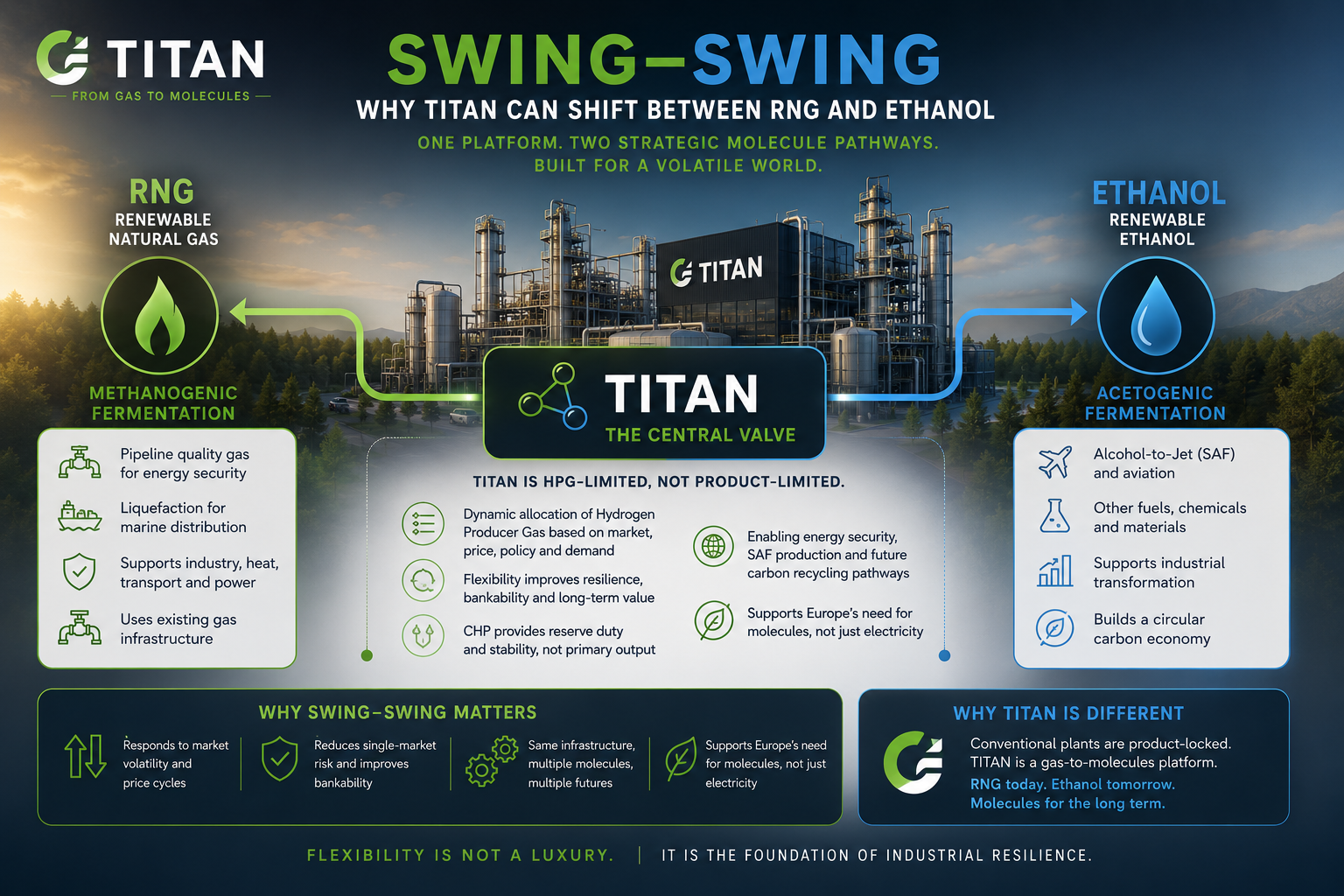
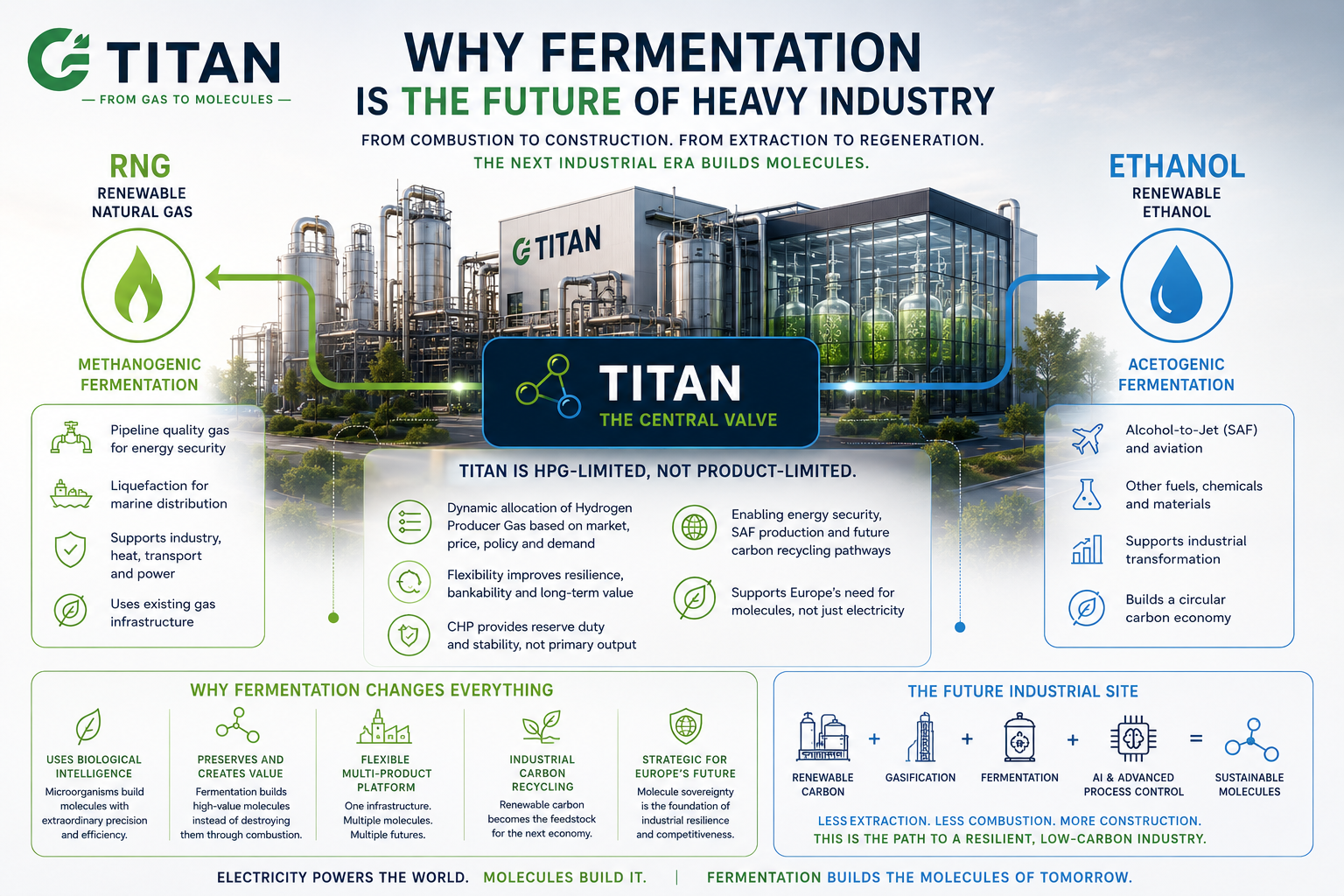
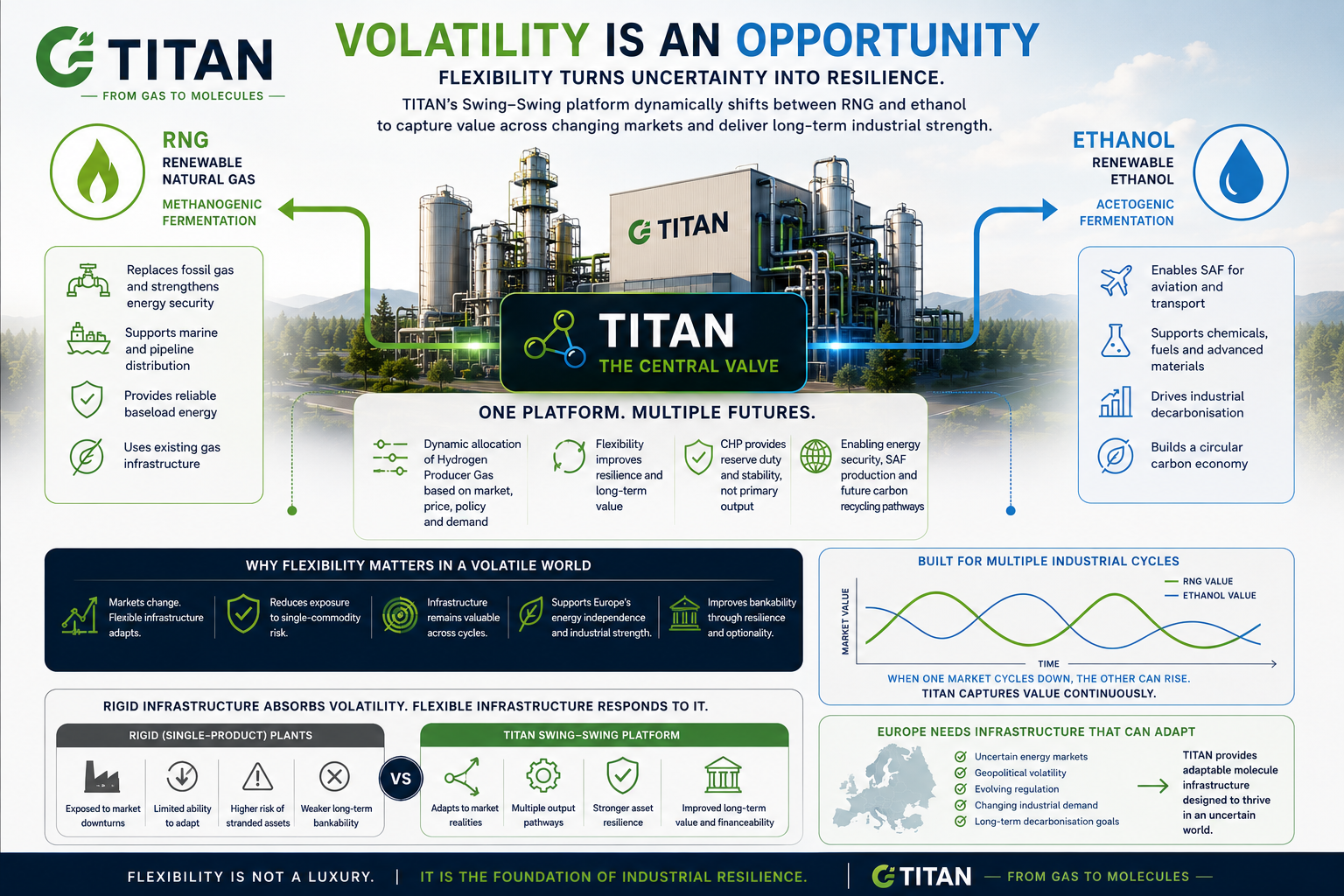
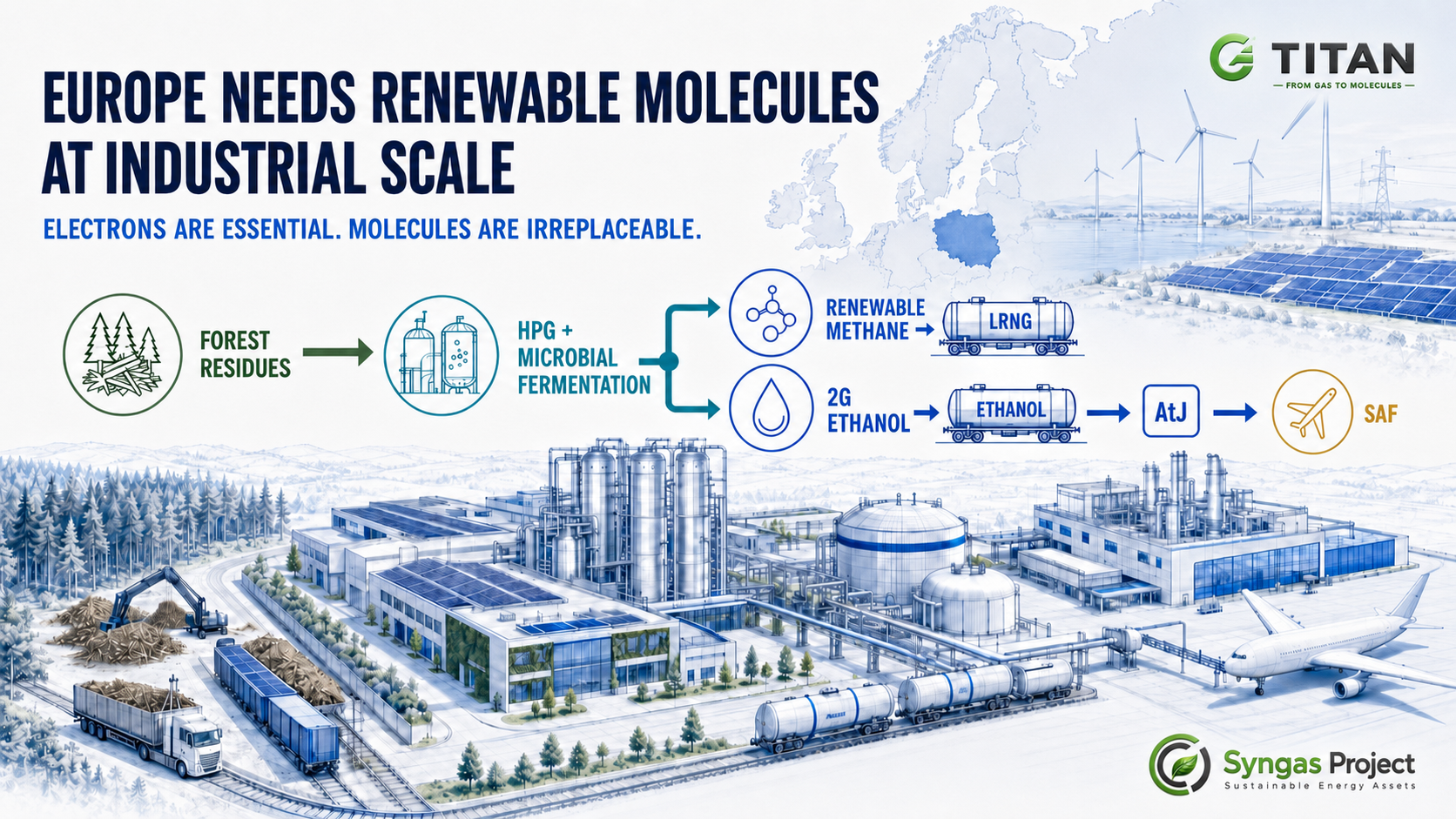
TITAN achieves this scale by combining Hydrogen Producer Gas with industrialised biotechnology. Hydrogen Producer Gas creates the controllable carbon feedstock. Methanogenic fermentation converts that feedstock into renewable methane. Acetogenic fermentation converts it into 2G ethanol for SAF intermediates. These outputs are not competing products. They operate side by side in Swing–Swing mode, where shared gas supply, heat integration, utilities, operational flexibility and market optionality allow each pathway to support the other.

The result is not simply renewable gas production and not simply ethanol production. It is an integrated carbon-to-molecule platform.

This matters because Europe needs both gas and liquid fuels. Renewable methane can replace fossil LNG in existing gas logistics, virtual pipeline systems and industrial demand centres. 2G ethanol can support the alcohol-to-jet pathway for sustainable aviation fuel. Together, they create a stronger platform than either output alone.

Syngas Project’s first base is Poland. The long-term objective is to establish the platform capacity required to support a Polish SAF refinery capable of producing 1 million litres per day by 2035, while also building the renewable gas infrastructure needed to deliver approximately 1 GW of RNG-equivalent capacity through Swing–Swing deployment.
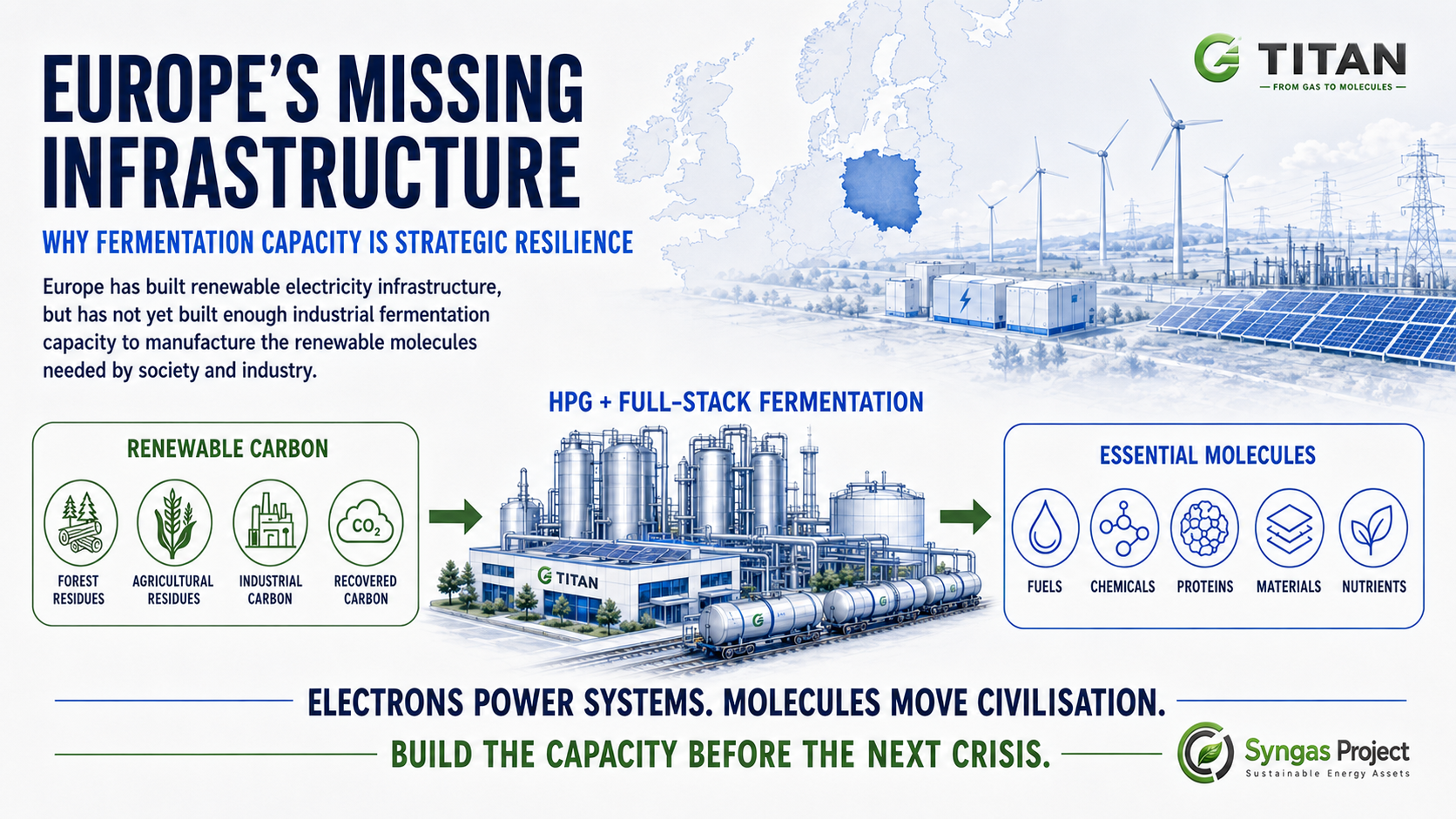
This is possible because industrialised biotechnology, not waste-to-energy, does the heavy lifting.

TITAN is not a larger version of a biogas plant. It is a different class of infrastructure: a carbon-to-molecule manufacturing platform designed for renewable gas today, SAF intermediates today, and future fuels, chemicals, materials and nutrients as microbial pathways expand.

Europe does not need symbolic carbon recycling. Europe needs industrial carbon recycling at scale.

TITAN is built for that scale.

From Project to Infrastructure

The transition to renewable molecules will not be delivered by incremental technologies. It requires platforms that operate at industrial scale, integrate with existing infrastructure and deliver multiple outputs with operational flexibility.

TITAN is designed to meet that requirement.

By combining Hydrogen Producer Gas with industrialised fermentation, and by deploying Swing–Swing operation from the outset, TITAN moves beyond single-product thinking. It creates a platform capable of supplying renewable gas, supporting SAF production and expanding into future chemical and material pathways as biotechnology evolves.

This is not a future concept. It is a deployable system.

As Europe moves to secure its energy, industrial base and supply chains, the ability to manufacture molecules locally from recycled carbon becomes a strategic capability.

TITAN provides that capability.

Polish Version

Europa potrzebuje cząsteczek odnawialnych w skali przemysłowej

Europa osiągnęła znaczący postęp w obszarze odnawialnej energii elektrycznej, jednak system cząsteczek pozostaje narażony. Gaz, paliwa ciekłe, surowce chemiczne oraz przyszłe materiały nadal w dużej mierze opierają się na łańcuchach dostaw opartych na paliwach kopalnych. Tych cząsteczek nie da się zastąpić wyłącznie energią elektryczną. Muszą być wytwarzane na nowo — w inny sposób.

W tym miejscu TITAN zmienia skalę dyskusji.

Typowa instalacja fermentacji beztlenowej produkuje około 2 milionów metrów sześciennych gazu odnawialnego rocznie. To użyteczne, ale nie wpływa na bezpieczeństwo energetyczne na poziomie krajowym. TITAN został zaprojektowany dla zupełnie innej klasy produkcji. W trybie Swing–Swing w Fazie Pierwszej, produkując równolegle metan odnawialny i etanol, pojedyncza instalacja TITAN może osiągnąć około 22 milionów metrów sześciennych ekwiwalentu RNG rocznie. Przy zainstalowanych w Fazie Pierwszej pierwszych 50 MW z docelowych 100 MW zdolności RNG, ta sama instalacja posiada ścieżkę wzrostu do około 44 milionów metrów sześciennych RNG, przy czym jedna z dziesięciu planowanych pełnoskalowych instalacji TITAN może przekroczyć 80 milionów metrów sześciennych ekwiwalentu RNG rocznie.

To nie jest marginalna poprawa. To skokowa zmiana w infrastrukturze odnawialnych cząsteczek.

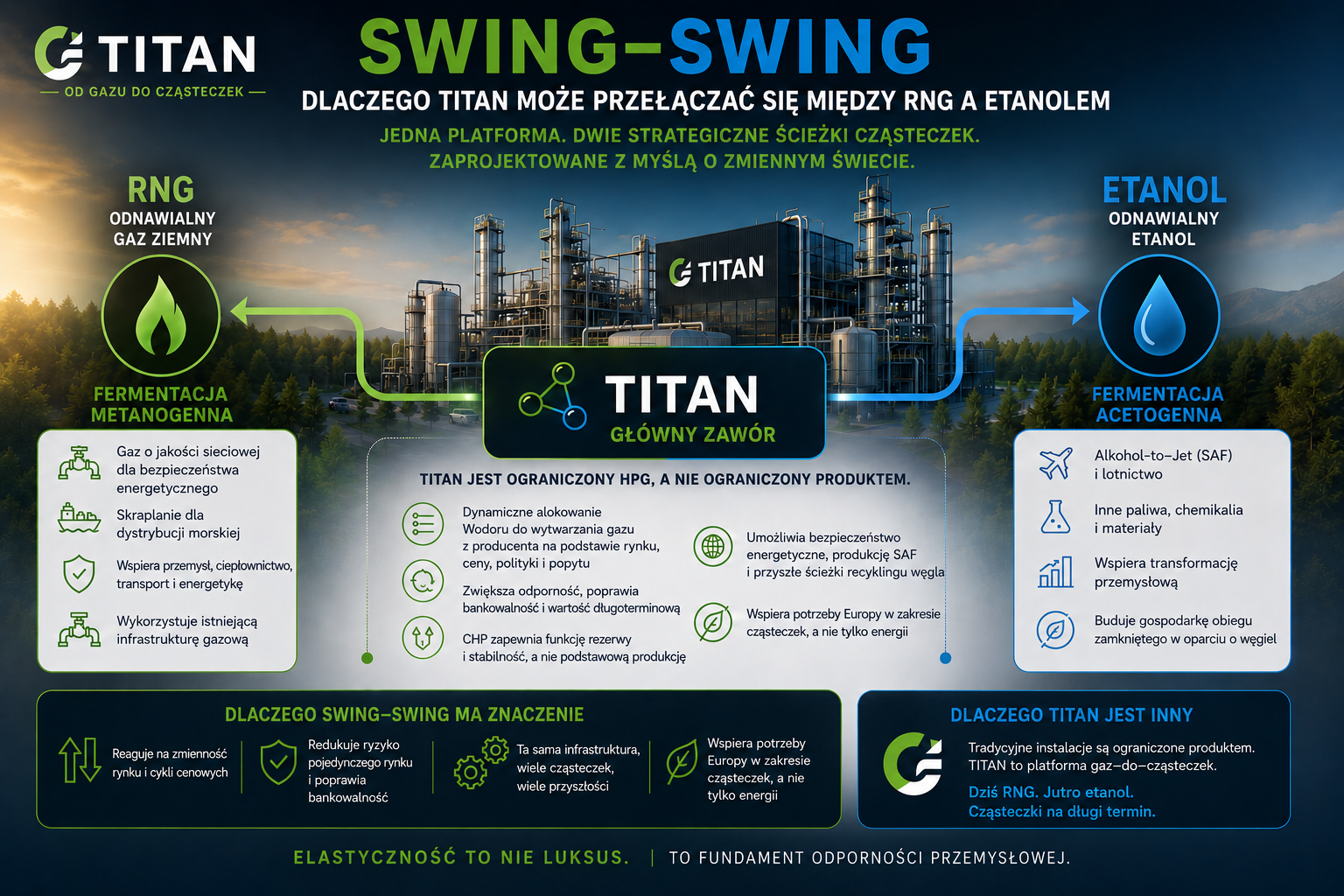
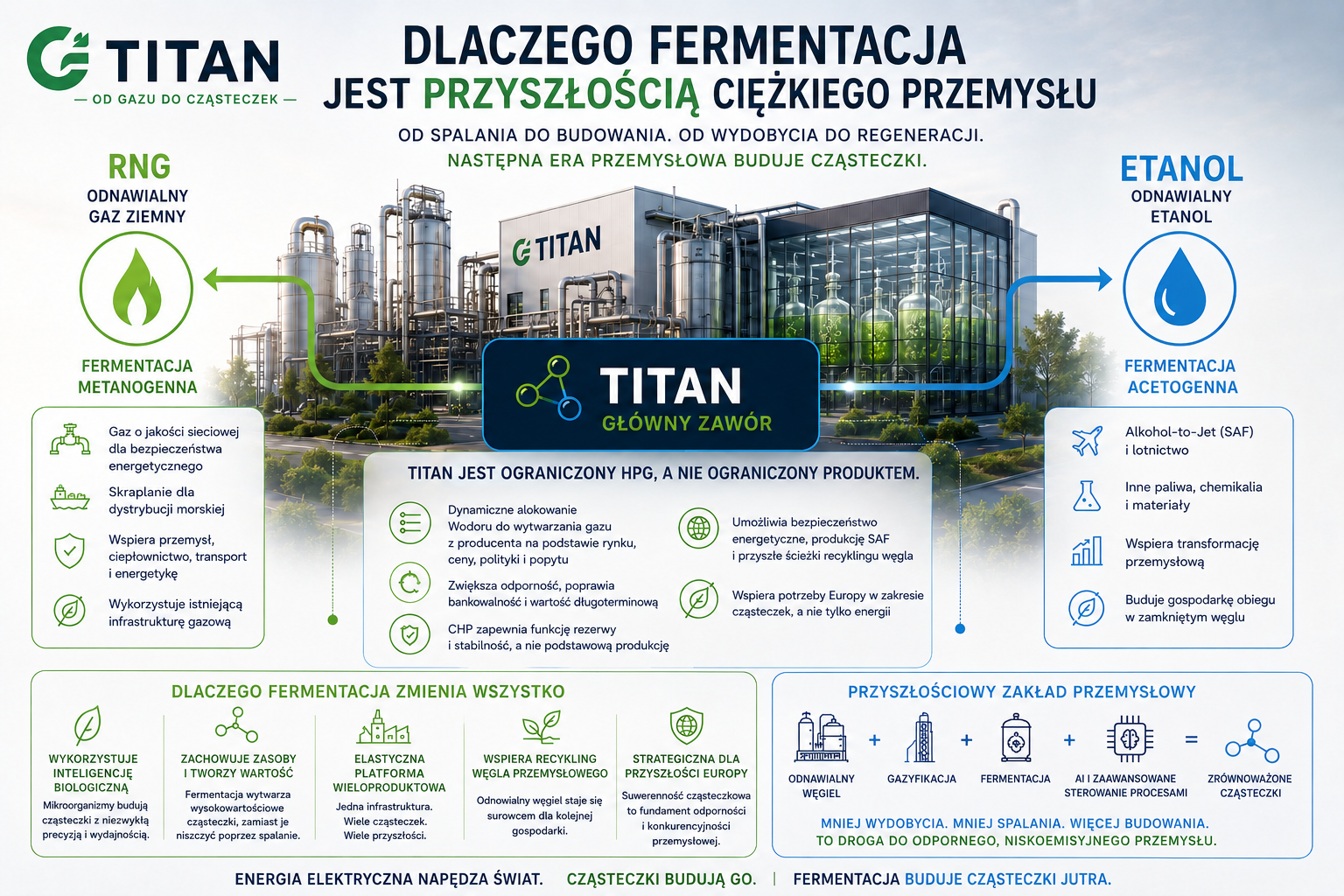
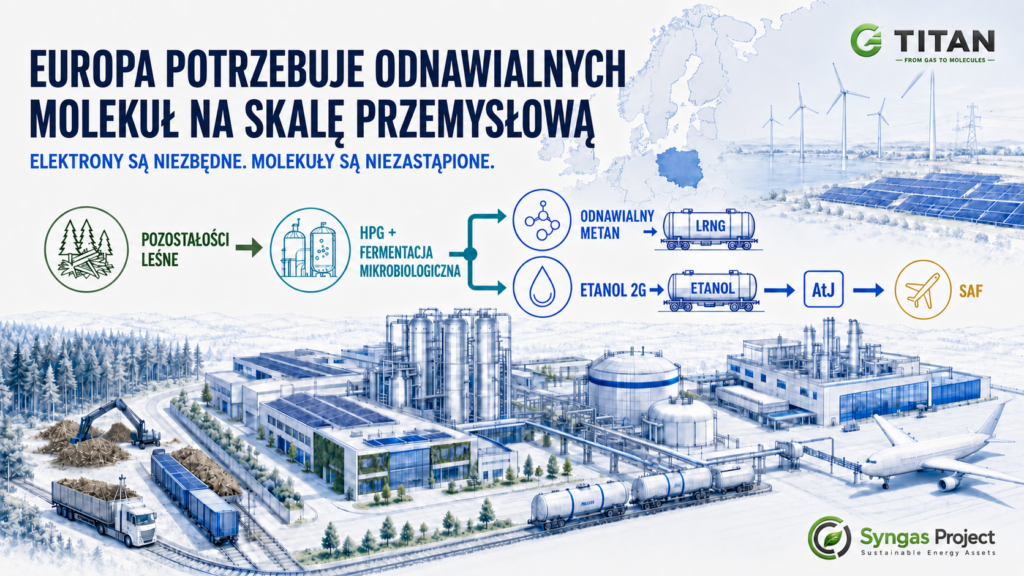
TITAN osiąga tę skalę poprzez połączenie Hydrogen Producer Gas z uprzemysłowioną biotechnologią. Hydrogen Producer Gas tworzy kontrolowalny nośnik węgla. Fermentacja metanogenna przekształca go w metan odnawialny. Fermentacja acetogenna przekształca go w etanol drugiej generacji jako półprodukt dla SAF. Te produkty nie konkurują ze sobą. Działają równolegle w trybie Swing–Swing, gdzie wspólne zasilanie gazem, integracja cieplna, infrastruktura pomocnicza, elastyczność operacyjna oraz opcjonalność rynkowa pozwalają obu ścieżkom wzajemnie się wzmacniać.

Rezultatem nie jest jedynie produkcja gazu odnawialnego ani jedynie produkcja etanolu. Jest nim zintegrowana platforma przekształcania węgla w cząsteczki.

Ma to znaczenie, ponieważ Europa potrzebuje zarówno gazu, jak i paliw ciekłych. Metan odnawialny może zastąpić kopalny LNG w istniejącej logistyce gazowej, systemach wirtualnych rurociągów oraz w odbiorcach przemysłowych. Etanol 2G może zasilać ścieżkę alcohol-to-jet dla zrównoważonego paliwa lotniczego. Razem tworzą silniejszą platformę niż każdy z tych produktów osobno.

Pierwszą bazą Syngas Project jest Polska. Długoterminowym celem jest stworzenie zdolności platformy pozwalającej na wsparcie rafinerii SAF w Polsce o wydajności 1 miliona litrów dziennie do 2035 roku, przy jednoczesnym budowaniu infrastruktury gazu odnawialnego zdolnej dostarczyć około 1 GW mocy w ekwiwalencie RNG poprzez wdrożenia Swing–Swing.

Jest to możliwe, ponieważ to uprzemysłowiona biotechnologia — a nie waste-to-energy — wykonuje kluczową pracę.

TITAN nie jest większą wersją instalacji biogazowej. To inna klasa infrastruktury: platforma przemysłowa przekształcająca węgiel w cząsteczki, zaprojektowana dla produkcji gazu odnawialnego dziś, półproduktów SAF dziś oraz przyszłych paliw, chemikaliów, materiałów i składników odżywczych w miarę rozwoju mikrobiologii.

Europa nie potrzebuje symbolicznego recyklingu węgla. Europa potrzebuje przemysłowego recyklingu węgla w skali.

TITAN jest zaprojektowany dla tej skali.


Od projektu do infrastruktury

Transformacja w kierunku odnawialnych cząsteczek nie zostanie osiągnięta poprzez technologie przyrostowe. Wymaga platform działających w skali przemysłowej, zintegrowanych z istniejącą infrastrukturą oraz zdolnych do dostarczania wielu produktów przy zachowaniu elastyczności operacyjnej.

TITAN został zaprojektowany, aby spełnić te wymagania.

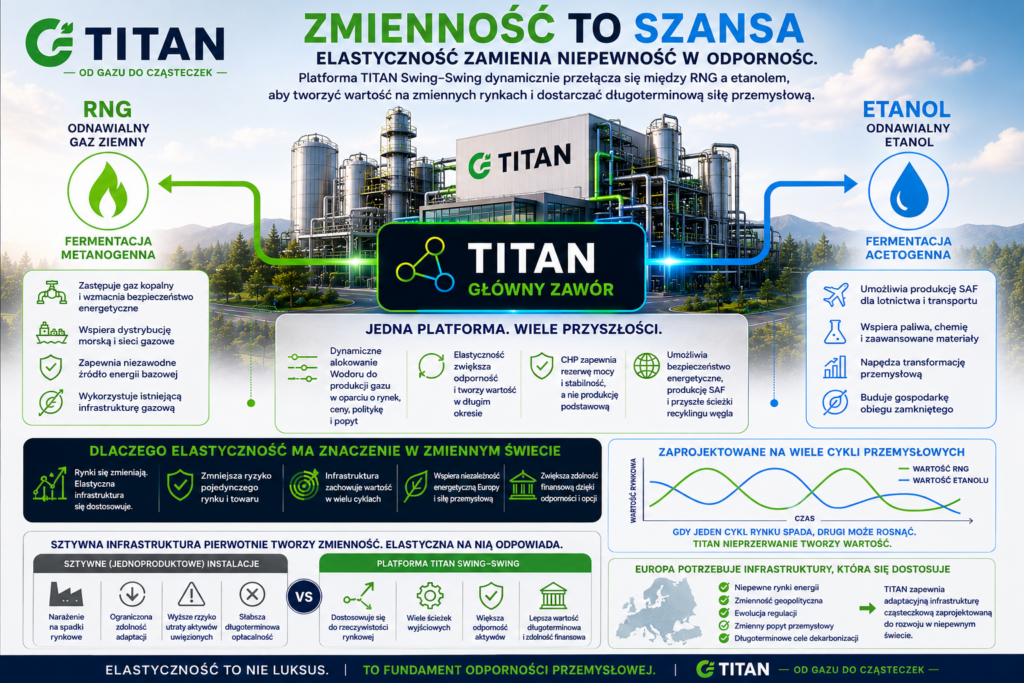
Poprzez połączenie Hydrogen Producer Gas z uprzemysłowioną fermentacją oraz wdrożenie trybu Swing–Swing od samego początku, TITAN wychodzi poza model pojedynczego produktu. Tworzy platformę zdolną do dostarczania gazu odnawialnego, wspierania produkcji SAF oraz rozszerzania działalności o przyszłe ścieżki chemiczne i materiałowe wraz z rozwojem biotechnologii.

To nie jest koncepcja przyszłości. To system gotowy do wdrożenia.

W miarę jak Europa dąży do zabezpieczenia swojej energii, bazy przemysłowej i łańcuchów dostaw, zdolność do lokalnej produkcji cząsteczek z odzyskanego węgla staje się kompetencją strategiczną.

TITAN dostarcza tę kompetencję.

Renewable Methane at Scale: LRNG and the Return of Local Gas

(Przewiń w dół, aby zobaczyć wersję polską)

Europe does not have a gas problem. It has a gas origin problem.

Methane remains essential. It fuels industry, supports energy resilience, underpins logistics and provides the backbone for large parts of the economy that cannot simply electrify. The system that distributes methane is already built. What is changing is not the need for gas, but where that gas comes from.

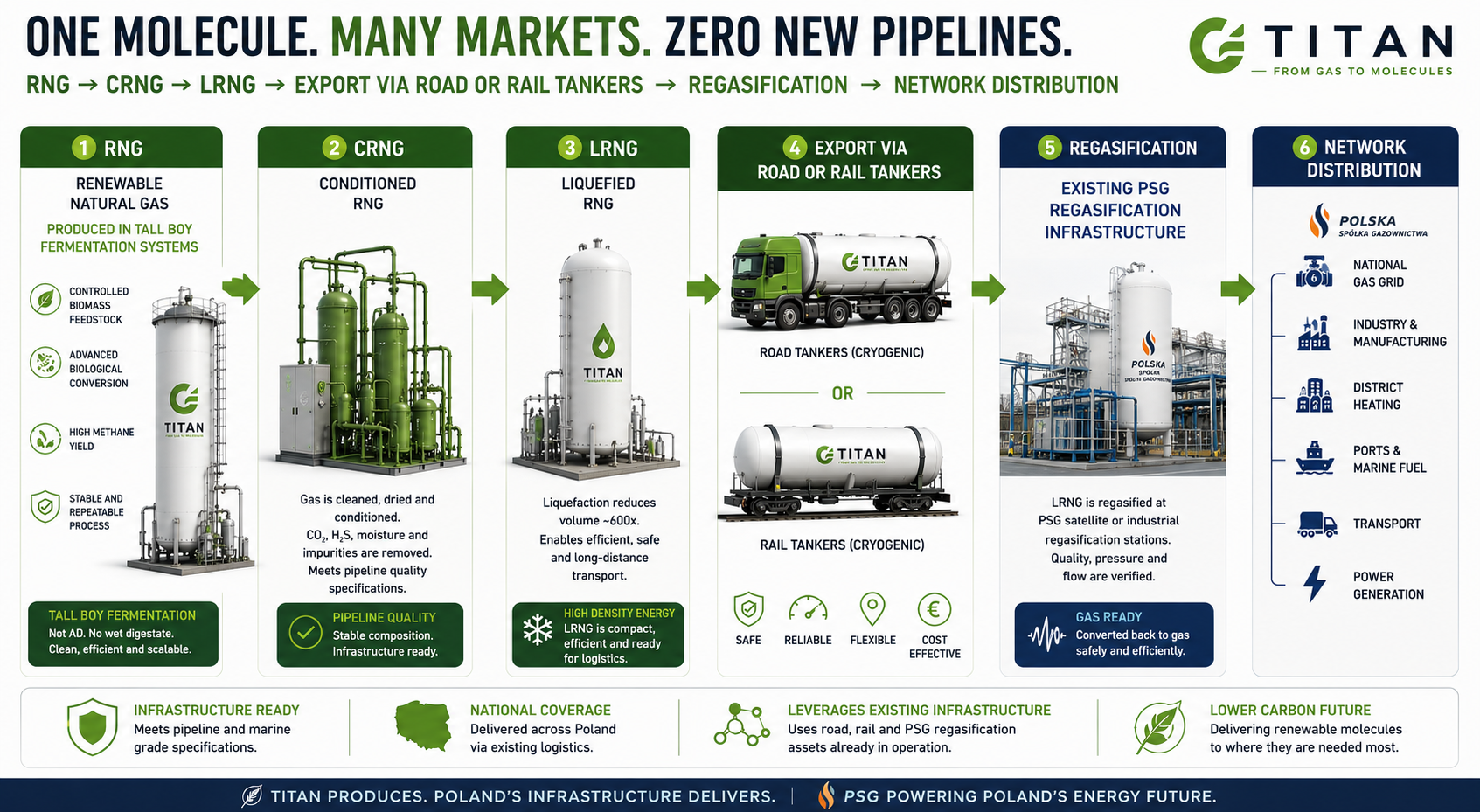
Today, gas is distributed increasingly in liquefied form. LNG has already proven the model. Methane is cooled, liquefied and reduced to around 1/600th of its original volume. It is then transported efficiently by ship, rail or road tanker, delivered to a local hub, regasified and supplied into the network.

This is not a workaround. It is the system.

Many still think LNG distribution is an excuse for not having pipelines. That is wrong. LNG is a more targeted delivery system. The local hub receives the gas it ordered, not a blended molecule that entered a pipeline thousands of kilometres away. The control point moves from the pipeline to the destination.

The real legacy of the gas system is not the intercontinental pipeline.

It is the local gas network.

Historically, gas was produced locally and distributed locally. Towns and industrial centres had their own gas production linked directly to local demand. Long-distance pipelines came much later. They replaced local producers and centralised supply, often for convenience and scale. For a period, that worked.

Today, that model is under pressure.

Russia to the east is no longer a reliable source. Conflict in the Middle East continues to destabilise global energy flows. The United States is becoming less dependable as a long-term strategic partner. Norway carried Europe through the immediate crisis, but it is past peak. It delivered when needed, but production will not keep expanding. The longer global instability continues, the more pressure is placed on a limited northern supply base.

Europe is still climbing an import ladder that is no longer secure.

At some point, that ladder has to be left behind.

Poland has an alternative.

Poland already operates a distributed gas system. The LNG terminal near Szczecin has been built out from approximately 6 billion cubic metres toward 8 billion cubic metres of capacity. More importantly, more than 100 LNG regasification gas islands developed by PSG already form a decentralised distribution network across the country.

These are not temporary assets. They are long-life infrastructure.

The missing piece is not distribution.

The missing piece is local production at scale.

This is where TITAN comes in.

TITAN is designed to produce renewable methane gas from recycled carbon using Hydrogen Producer Gas and industrialised biotechnology. The gas is not a by-product. It is the primary output of a controlled system. Hydrogen Producer Gas creates a stable and manageable carbon feedstock. Methanogenic fermentation converts that feedstock into renewable methane.

That methane can then be compressed, buffered, liquefied and shipped as LRNG — liquefied renewable natural gas.

LRNG is the direct renewable twin of LNG.

Same molecule. Same logistics. Same infrastructure.

Different carbon origin.

The challenge has never been the ability to produce renewable methane. The challenge has been scale.

Most renewable gas solutions operate at small volumes. A typical anaerobic digestion plant may produce around 2 million cubic metres of gas per year. That has local value, but it does not replicate the gas system.

TITAN is built to replicate the system.

In Phase One Swing–Swing operation, a TITAN site produces around 22 million cubic metres of RNG equivalent per year while also producing ethanol as part of the integrated platform. That is the starting point. With the first 50 MW of a future 100 MW methane capability installed in Phase One, the same site has a clear scaling pathway: 22 million, 44 million, 66 million and ultimately more than 80 million cubic metres of RNG equivalent per year at full-site capacity.

At this level, gas production is no longer marginal.

It becomes infrastructure.

At this scale, methane can be liquefied, transported and delivered into the existing gas system as LRNG. It can be moved efficiently at 1/600th of its volume, delivered by road or rail tanker to gas islands and regasified into local networks.

This is the virtual pipeline in its true form.

Not an excuse for missing pipelines, but a deliberate system design where production and delivery are matched directly to demand.

When methane is produced locally at this scale, it becomes competitive.

It competes on quality, cost and delivery time. It removes exposure to geopolitical volatility. It reduces dependency on imported gas pricing. It aligns production with national infrastructure. It delivers a Polish molecule into a Polish system.

Convenience once favoured pipelines.

Today, energy security outweighs convenience.

LRNG closes that gap.

It combines the efficiency of liquefied transport with the control of local production. It allows gas to be manufactured, moved and delivered without relying on unstable supply corridors.

This is not waste-to-energy.

This is industrial methane production through biotechnology.

TITAN is not a biogas plant scaled up. It is a different class of system. Industrialised fermentation does the heavy lifting, converting controlled gas into renewable methane at a scale that matches infrastructure. The result is a stable, dispatchable molecule that fits directly into the LNG and gas island model already operating across Poland.

The system does not need to be rebuilt.

It needs to be supplied differently.

Poland has the infrastructure. Poland has the logistics. Poland has the demand.

What Poland needs is methane produced at scale, locally, without geopolitical exposure.

TITAN provides that capability.

The longer global instability continues — in the east, in the Middle East, and across shifting alliances — the more pressure is placed on existing supply sources. Norway cannot expand indefinitely. Imports cannot be assumed forever. The system will tighten.

The decision point is clear.

Continue climbing the import ladder.

Or step off and build local methane infrastructure.

LRNG makes that possible.

TITAN makes it scalable.

Renewable methane is not a future idea.

It is ready.

At scale, it becomes the system.

Metan odnawialny w skali przemysłowej: LRNG i powrót do lokalnej produkcji gazu

Europa nie ma problemu z gazem. Europa ma problem z pochodzeniem gazu.

Metan pozostaje niezbędny. Zasila przemysł, wspiera odporność energetyczną, stanowi podstawę logistyki i obsługuje dużą część gospodarki, której nie da się po prostu zelektryfikować. System dystrybucji metanu już istnieje. Zmienia się nie potrzeba korzystania z gazu, lecz źródło jego pochodzenia.

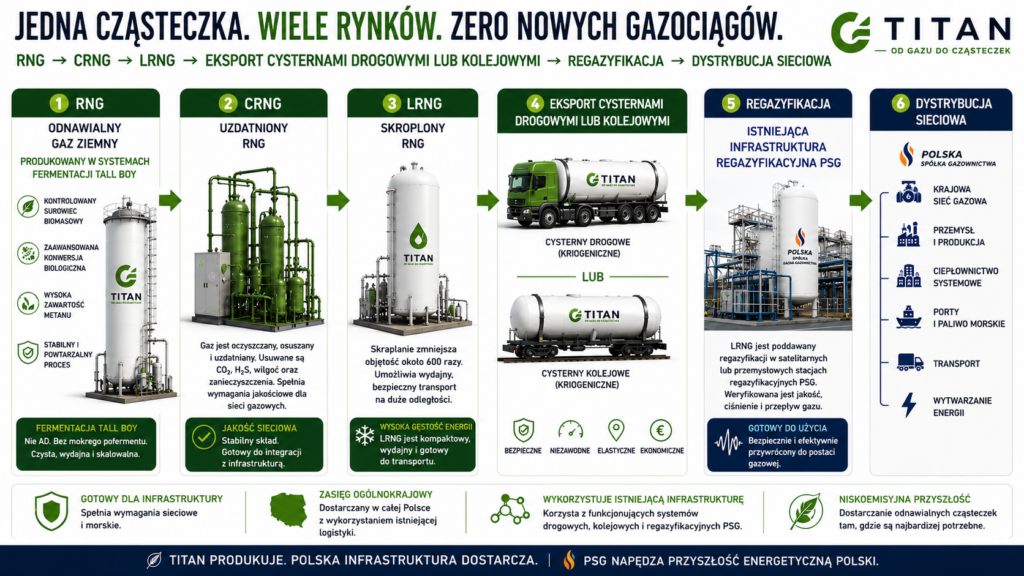
Dziś gaz jest coraz częściej dystrybuowany w formie skroplonej. LNG już udowodniło ten model. Metan jest schładzany, skraplany i zmniejszany objętościowo do około 1/600 swojej pierwotnej objętości. Następnie może być sprawnie transportowany statkiem, koleją lub cysterną drogową, dostarczany do lokalnego hubu, regazyfikowany i wprowadzany do sieci.

To nie jest rozwiązanie zastępcze. To jest system.

Wiele osób nadal błędnie uważa, że dystrybucja LNG jest tylko usprawiedliwieniem dla braku gazociągu. To nieprawda. LNG jest bardziej precyzyjnym systemem dostarczania gazu. Lokalny hub otrzymuje gaz, który zamówił, a nie wymieszaną cząsteczkę, która weszła do rurociągu tysiące kilometrów dalej. Punkt kontroli przesuwa się z rurociągu do miejsca dostawy.

Prawdziwym dziedzictwem systemu gazowego nie jest gazociąg międzykontynentalny.

Jest nim lokalna sieć gazowa.

Historycznie gaz był produkowany lokalnie i lokalnie dystrybuowany. Miasta i ośrodki przemysłowe miały własnych producentów gazu, bezpośrednio połączonych z lokalnym popytem. Gazociągi dalekiego zasięgu pojawiły się dużo później. Zastąpiły lokalnych producentów i scentralizowały dostawy, często ze względu na wygodę i skalę. Przez pewien czas ten model działał.

Dziś znajduje się pod presją.

Rosja na wschodzie nie jest już wiarygodnym źródłem. Konflikt na Bliskim Wschodzie nadal destabilizuje globalne przepływy energii. Stany Zjednoczone stają się mniej przewidywalnym partnerem strategicznym w długim terminie. Norwegia przeprowadziła Europę przez natychmiastowy kryzys, ale jest już po szczycie wydobycia. Dostarczyła gaz wtedy, gdy był potrzebny, ale produkcja nie będzie dalej rosła. Im dłużej trwa globalna niestabilność, tym większa presja spada na ograniczoną północną bazę dostaw.

Europa nadal wspina się po drabinie importowej, która nie jest już bezpieczna.

W pewnym momencie trzeba z tej drabiny zejść.

Polska ma alternatywę.

Polska już posiada rozproszony system gazowy. Terminal LNG w pobliżu Szczecina został rozbudowany z około 6 miliardów metrów sześciennych w kierunku około 8 miliardów metrów sześciennych przepustowości. Co ważniejsze, ponad 100 wysp regazyfikacyjnych LNG rozwijanych przez PSG tworzy już zdecentralizowaną sieć dystrybucji w całym kraju.

To nie są aktywa tymczasowe. To infrastruktura długoterminowa.

Brakującym elementem nie jest dystrybucja.

Brakującym elementem jest lokalna produkcja w skali.

W tym miejscu pojawia się TITAN.

TITAN został zaprojektowany do produkcji odnawialnego metanu z odzyskanego węgla przy użyciu Hydrogen Producer Gas i uprzemysłowionej biotechnologii. Gaz nie jest produktem ubocznym. Jest podstawowym produktem kontrolowanego systemu. Hydrogen Producer Gas tworzy stabilny i zarządzalny surowiec węglowy w fazie gazowej. Fermentacja metanogenna przekształca ten surowiec w metan odnawialny.

Ten metan może następnie zostać sprężony, zbuforowany, skroplony i wysłany jako LRNG — skroplony odnawialny gaz ziemny.

LRNG jest bezpośrednim odnawialnym bliźniakiem LNG.

Ta sama cząsteczka. Ta sama logistyka. Ta sama infrastruktura.

Inne pochodzenie węgla.

Wyzwanie nigdy nie polegało na samej możliwości produkcji odnawialnego metanu. Wyzwanie polegało na skali.

Większość rozwiązań w zakresie gazu odnawialnego działa przy małych wolumenach. Typowa instalacja fermentacji beztlenowej może produkować około 2 milionów metrów sześciennych gazu rocznie. Ma to wartość lokalną, ale nie odtwarza systemu gazowego.

TITAN został zbudowany, aby ten system odtworzyć.

W Fazie Pierwszej, w trybie Swing–Swing, jedna instalacja TITAN produkuje około 22 milionów metrów sześciennych ekwiwalentu RNG rocznie, jednocześnie produkując etanol jako część zintegrowanej platformy. To punkt wyjścia. Przy pierwszych 50 MW z przyszłej zdolności metanowej 100 MW zainstalowanych w Fazie Pierwszej, ta sama instalacja posiada jasną ścieżkę skalowania: 22 miliony, 44 miliony, 66 milionów i ostatecznie ponad 80 milionów metrów sześciennych ekwiwalentu RNG rocznie przy pełnej zdolności site’u.

Na tym poziomie produkcja gazu przestaje być marginalna.

Staje się infrastrukturą.

W tej skali metan może być skraplany, transportowany i dostarczany do istniejącego systemu gazowego jako LRNG. Może być przewożony efektywnie przy 1/600 swojej objętości, dostarczany cysterną drogową lub kolejową do wysp gazowych i regazyfikowany do lokalnych sieci.

To jest prawdziwa wirtualna rura.

Nie usprawiedliwienie dla brakujących gazociągów, lecz świadomie zaprojektowany system, w którym produkcja i dostawa są bezpośrednio dopasowane do popytu.

Kiedy metan jest produkowany lokalnie w tej skali, staje się konkurencyjny.

Konkuruje jakością, kosztem i czasem dostawy. Usuwa ekspozycję na zmienność geopolityczną. Zmniejsza zależność od cen importowanego gazu. Dopasowuje produkcję do krajowej infrastruktury. Dostarcza polską cząsteczkę do polskiego systemu.

Wygoda kiedyś przemawiała za gazociągami.

Dziś bezpieczeństwo energetyczne jest ważniejsze niż wygoda.

LRNG zamyka tę lukę.

Łączy efektywność transportu skroplonego gazu z kontrolą lokalnej produkcji. Pozwala wytwarzać, przemieszczać i dostarczać gaz bez polegania na niestabilnych korytarzach dostaw.

To nie jest waste-to-energy.

To przemysłowa produkcja metanu przy użyciu biotechnologii.

TITAN nie jest powiększoną biogazownią. To inna klasa systemu. Uprzemysłowiona fermentacja wykonuje kluczową pracę, przekształcając kontrolowany gaz w metan odnawialny w skali odpowiadającej infrastrukturze. Rezultatem jest stabilna, dyspozycyjna cząsteczka, która bezpośrednio pasuje do modelu LNG i wysp gazowych już funkcjonujących w Polsce.

Systemu nie trzeba budować od nowa.

Trzeba go zasilać inaczej.

Polska ma infrastrukturę. Polska ma logistykę. Polska ma popyt.

Polska potrzebuje metanu produkowanego lokalnie, w skali i bez ekspozycji geopolitycznej.

TITAN dostarcza tę zdolność.

Im dłużej trwa globalna niestabilność — na wschodzie, na Bliskim Wschodzie i w ramach zmieniających się sojuszy — tym większa presja spada na istniejące źródła dostaw. Norwegia nie może zwiększać produkcji w nieskończoność. Importu nie można zakładać na zawsze. System będzie się zacieśniał.

Punkt decyzji jest jasny.

Dalej wspinać się po drabinie importowej.

Albo zejść z niej i zbudować lokalną infrastrukturę metanową.

LRNG sprawia, że jest to możliwe.

TITAN sprawia, że jest to skalowalne.

Metan odnawialny nie jest pomysłem na przyszłość.

Jest gotowy.

W skali staje się systemem.

The Heat We Can Afford – The Technology You Can’t Afford to Miss 

Warsaw Monday June 2, 2025

Poland’s district heating (DHN) infrastructure is both a legacy achievement and a growing liability. Half the country depends on centralised heat, yet the economic foundation of that system is in crisis. The cost to sustainably generate clean heat in Europe is around EUR 0.50 per kilowatt-hour. In Poland, the market pays only about EUR 0.25/kWh. This is not a viable business model. It is a slow failure in plain sight – a structural mismatch between what heat costs to produce and what consumers can afford to pay.

But what if there were a way to produce heat sustainably, affordably – and without relying on it as your main income stream? That’s the proposition of TITAN and ASMARA. These are not conventional power plants. They are modular, carbon-negative industrial platforms that happen to produce a lot of clean, surplus heat – and that changes everything.

Heat as a By-Product, Not a Revenue Anchor

TITAN’s Island One is a biomass-fuelled Combined Heat and Power (CHP) plant, running on forest residues converted into hydrogen producer gas. It produces stable, 24/7 electricity – and in doing so, generates significant volumes of usable heat. But this heat is not the commercial driver of the system. It is a process by-product.

Because TITAN’s business model does not depend on selling heat for profit, it can afford to export heat into Poland’s existing DHN pricing environment without financial strain. In fact, it thrives there – simply because heat is not our bottom line. That distinction makes TITAN a structural fit for the Polish context, where heat prices are capped and economic pressure is high.

TITAN next generation ethanol and the decarbonisation of our skies

Revised: Steve Walker 20.04.2025

TITAN: Next-Generation Ethanol and the Decarbonisation of Our Skies

As aviation and transport fuel regulations tighten across Europe, second-generation ethanol (2G EtOH) has emerged as a cornerstone in the EU’s clean fuel strategy. At the heart of this transition is TITAN, a bio-engineering platform that transforms forest waste into renewable fuel, replacing petroleum-based inputs with high-value, low-emission alternatives.

TITAN is not just a plant — it is a statement of intent. It reflects a deep commitment to energy sovereignty, local feedstock utilisation, and a truly circular economy. It also represents a strategic leap forward for Poland’s aviation sector, offering a domestic solution to one of Europe’s most urgent climate compliance challenges.

2G Ethanol: The Core of TITAN’s Mission

TITAN’s primary objective is the production of advanced, non-food-based 2G EtOH, sourced entirely from waste forest biomass. This includes residues left on the forest floor, non-virgin woody biomass, and materials historically destined for landfilling or low-grade combustion.

Using a proprietary Hydrogen Producer Gas (HPG) to Targeted Microbial Fermentation (TMF) process, TITAN extracts renewable carbon and hydrogen from biomass, converting it into 2G EtOH with near-zero refinery emissions and no fossil fuel input. The platform’s dual HPG island architecture ensures continuous and decentralised gas supply for both electricity/heat and fermentation feedstock.

This modular structure allows TITAN to function as a standalone, grid-independent, smoke-free, zero-coal facility, setting a new benchmark for carbon-negative industrial energy systems.

SAF Rollout and the Alcohol-to-Jet Pathway

The second phase of TITAN’s rollout will focus on producing Sustainable Aviation Fuel (SAF) through the Alcohol-to-Jet (AtJ) pathway. The AtJ process refines TITAN’s 2G ethanol into Jet-A1 compliant, drop-in aviation fuel, ready to blend at refuelling depots across Europe. The first ten TITAN installations produce enough 2G EtOH to supply an AtJ refinery producing Jet-A1 and Biodeisel

This development is perfectly aligned with the ReFuelEU Aviation Regulation, which mandates all EU airports begin blending sustainable aviation fuels starting at 2% in 2025, rising to 6% in 2030, 20% by 2035, and 28% by 2050. Airlines that do not comply must pay penalties.

TITAN’s SAF production will therefore not only enable Polish airlines to comply — it will allow them to lead. By producing SAF locally, Poland can secure its own fuel supply, reduce its carbon intensity per flight, and offer intercontinental connections from a net-zero baseline.

How the First Ten TITAN Platforms Will Unlock More Wind and Solar for the Polish Grid

Erik Wilde from Berkeley, CA, USA, CC BY-SA 2.0

Warsaw 20 May 2025

The future of Poland’s Green Energy Transition

Poland’s energy transition depends not only on building more solar and wind farms, but on ensuring these resources can be safely and reliably connected to the national grid. The TITAN platform, developed by Syngas Project offers a breakthrough solution: modular, rural-based energy infrastructure that enables the grid to absorb more intermittent renewables while delivering jobs, resilience, and fuel sovereignty.

The first ten TITANs are now entering deployment, each with a rated electrical output of 10 MWe, supported by 10 MW of reserve dispatchable capacity. These systems are specifically located in rural areas, where Poland’s grid is weakest and decentralised energy is most urgently needed. TITAN acts as a local grid stabiliser, absorbing local intermittency and enabling nearby wind and solar systems to feed clean power into the grid safely.

Each TITAN site creates more than 50 direct jobs, plus a wider network of local supply chain opportunities—from biomass harvesting and transport to equipment servicing and biochar sales. These installations form the backbone of a new rural energy economy, anchored in forest and agricultural waste streams.

How HPG+TMF Invented Lifestacking

Warsaw, 12 May, 2024

Lifestacking: A Value Proposition for Carbon Sovereignty

In the post-carbon era, success will not be defined by how much we extract from the Earth, but by how intelligently we reuse what we already have. That’s the principle behind “Lifestacking”, a new industrial model enabled by the integration of Hydrogen Producer Gas (HPG) and Targeted Microbial Fermentation (TMF). Developed and deployed by the Syngas Project, this approach doesn’t just recycle energy or materials; it recycles carbon, intelligently and endlessly.

The Problem with Linear Carbon Use

In traditional energy and industrial systems, carbon is a one-way ticket: extracted, combusted, emitted. Even so-called “green” solutions often fail to close the loop. They burn biomass and call it renewable, or capture CO2 only to inject it underground, removing it from the cycle entirely. These models fail to recognise the value of carbon as a feedstock, especially in a world where biology is ready to do the work.

How Lifestacking Works

Lifestacking is a process stack, a layered system where every step adds value, compounds efficiency, and deepens impact. The synergy between HPG and TMF unlocks a cascading value chain that transforms waste carbon into Fuel, Chemicals, Materials, and Nutrients (FCMN). But unlike traditional processes, nothing is burned or discarded. Instead, carbon is passed along, reprocessed, and transformed.

Warmth is Wealth: Rebuilding Poland’s Forgotten Towns through Renewable Heat and a New Rural Economy

Fix the Heat, and We Fix Economic Growth

Poland’s 400+ licensed district heating systems are not just engineering relics of a bygone era—they are also anchors for future prosperity. Many still run on coal or imported gas. Others are underfunded, deteriorating, and disconnected from the sweeping energy transition taking place in Warsaw or Berlin. But behind each rusting pipeline and coal-fired chimney is an opportunity: to decarbonise, regenerate, and redistribute.

Replacing district heating doesn’t just cut emissions. It lights the fire of a new economy—one rooted in local biomass, in new forms of clean hydrogen-rich gas, in circular carbon chemistry, and in the industrial capabilities of Poland’s people. This is not just about technology. It is about dignity, sovereignty, and equitable growth.

TITAN and ASMARA: Platforms for Change

The TITAN and ASMARA platforms, developed by Syngas Project and backed by strategic international partners, are not just cleaner energy systems. They are instruments of regeneration. Together, they deliver:

  • Smokeless, dispatchable heat and electricity through advanced gasification (HPG),
  • Second-generation ethanol and other fuels via targeted microbial fermentation (TMF),
  • Bio-based alternatives to imported chemicals, materials, and proteins,
  • Local employment across harvesting, logistics, engineering, and fermentation sciences,
  • And critically: a stable platform for economic development in places that globalisation left behind.

Each TITAN is modular and self-contained. It runs on regional forest residue, agricultural waste, or sorted urban waste streams. Each ASMARA complements TITAN by valorising complex municipal solid waste in urban zones. Together, they replace dependency with resilience—foreign fuel with local ingenuity.

Warsaw’s First Electrification Was Renewable — and It Lit the Path for a Cleaner Future

March 8th 2025 Warsaw

The technology behind today’s TITAN Project owes much to a quiet lineage of innovators who came long before the era of climate targets and carbon markets. Inspired by these early industrialists, TITAN builds upon a legacy where electricity was local, independent, and renewable by necessity, not marketing. We inherit that history with humility and pride.

In the late 19th century, long before municipal power grids were laid, Warsaw quietly switched on — not from coal, but from wood gas, plant oils, and German-built engines. Electricity in Poland did not arrive with smoke and ceremony. It arrived with intention, resilience, and a clear grasp of available resources.

The first confirmed electric lights in Warsaw came on in 1888, inside the military fortress at Żoliborz. A Deutz gasifier engine, burning wood chips and coke, provided a smokeless, off-grid supply of electricity to illuminate tunnels, barracks, and secure magazines. This was Poland’s first renewable electrification, and it was powered by wood — not wires.

That same year, a second Deutz unit was installed at the Towarowa freight yard, where the Vienna–Warsaw Railway extended eastward via the Warsaw–Terespol line. Contrary to common retellings, the Warsaw–Terespol Railway was laid in standard European gauge, only transitioning to Russian broad gauge at the border town of Terespol. In Warsaw, Towarowa had become one of the busiest and most sensitive freight depots in the region — and its electric lights, powered by a local wood gas engine, served a strategic purpose. On dark winter nights, those lights allowed the military to deter undesirables, track movements, and maintain order amid the chaos of the city’s growing trade and customs corridor.

Then, in 1889, Austrian engineer Marschel & Co. delivered Warsaw’s first commercial electric lighting system to the woollen hand-finishing workshops of Praga, not far from where the vodka factory would soon be built. These workshops, connected to the rising Brühl textile estate, operated without chimneys, without soot — and without interruption. Their Deutz generator lit the benches of men and women who worked wool into fine garments for markets east and west. And they did so two full years before the first coal-fired generator ever arrived at the much-acclaimed vodka distillery.

This was decentralised electricity. It was locally fuelled. It was renewable.

After AI – Warm Robots

The Machines That Heal—and the Circular Economy They’re Building

She looks almost human. Porcelain skin, careful eyes, anatomical symmetry—delicate, not threatening. A beautiful contradiction. The image evokes a future we’ve long imagined: robots that walk beside us, feel with us, care for us.

But this isn’t the warm robot we meant.

Because the real warm robots—ours—don’t smile or stand. They don’t blink, speak, or age.
They are microbes.
Alive, invisible, programmable.

They live in tanks. They breathe carbon. They manufacture the building blocks of the post-pollution world: fuels, chemicals, nutrients, and materials. And now, aided by generative AI, they are evolving—stacking complexity, mimicking natural processes, and operating with the efficiency of the human brain and the regenerative elegance of skin and bone.

We call this new capability Industrial Lifestacking.
It’s not robotics. It’s regeneration.
Not imitation—but biological infrastructure, scaled.

The Living Stack

Long before artificial intelligence could speak, microbes were building. While generative models were still learning language, fermentation vessels were already producing ethanol, biodegradable polymers, and essential proteins from nothing more than carbon waste and biological design.

What makes this possible is a structure we call the Living Stack—a three-layered system that turns industrial chaos into organic precision:

AI serves as the design layer, where biological systems are mapped, metabolic pathways are simulated, and yield efficiency is optimised.
Gene Editing functions as the software layer, rewriting microbial DNA to perform intentional functions—from synthesising alcohols to building amino acid chains.
Targeted Microbial Fermentation (TMF) forms the hardware layer, where gas-fed microbes in controlled environments transform design and code into physical product.

This stack doesn’t run on electricity alone. It runs on carbon. It doesn’t output noise or abstraction. It outputs life.

Leveraging Direct Air Capture (DAC) for Targeted Microbial Fermentation

Harnessing PEGASUS: Direct Air Capture Meets HPG + TMF in the Race to Regenerate Carbon

How TITAN and ASMARA transform carbon from problem to product in line with EU priorities

As Europe confronts rising temperatures, tightening emissions targets, and increasing resource instability, a fundamental shift is underway: carbon is no longer seen only as waste, but as feedstock. This shift is visible in new industrial strategies, circular economy goals, and bioeconomy frameworks—but it needs infrastructure to deliver.

That’s where PEGASUS, a modular Direct Air Capture (DAC) system developed for integration with the TITAN and ASMARA platforms, enters the picture. It offers a breakthrough solution: capturing carbon from the air or industrial sources and transforming it into fuels, chemicals, materials, or even nutrients, via the microbial fermentation infrastructure already embedded within TITAN and ASMARA.

This is not speculative. It is already working in pilot, and it fits squarely within existing and forthcoming EU directives.

TITAN and ASMARA: Carbon-Circular by Design

TITAN, built for rural zones, converts forest and agricultural waste into hydrogen-rich gas (HPG) and uses microbial fermentation (TMF) to convert that gas into second-generation ethanol, biochemicals, and energy. ASMARA performs the same function in urban areas using sorted municipal solid waste (MSW). These platforms are modular, scalable, and already aligned with Europe’s Green Deal, REPowerEU, and Fit for 55 objectives.

Adding PEGASUS enhances these platforms by introducing a steady, high-purity stream of captured CO₂, which TMF microbes can metabolise directly. Rather than storing the carbon underground, as most current DAC-to-CCS models propose, PEGASUS routes the carbon into productive pathways—ensuring economic as well as ecological value.

This becomes especially powerful when blending CO₂ from multiple sources. For example:

  • Captured emissions from cement or steel plants (typically high in volume but lower in purity),
  • Ambient CO₂ captured via PEGASUS DAC (typically lower in volume but high in purity).

Blending both streams produces an optimised fermentation feedstock suitable for high-volume biofuels or specialised bio-based outputs. In fact, the purity of DAC opens entirely new metabolic pathways, allowing the production of advanced molecules such as bio-based solvents, high-purity organic acids, or even smart proteins like insulin analogues and bioactive lipids.

This is not just a carbon-negative process. It is biomanufacturing from thin air.